CO2 Calculator for Business
Helping companies see the value in going green.
How can companies monitor their ecological footprint, and why should they? In this project I worked with a start-up that offers a CO2 calculator for businesses.
It was a field I knew nothing about, and there seemed to be no end to the information out there. After the research, I focused on the calculator itself: a clearer structure and a cleaner interface.
Client
EKA x Sustaxo
Year
2023

The challenge
The scope was to improve onboarding for new customers. Two fellow students and I looked at competitors, read up on Estonian and EU legislation, and interviewed businesses that had finished the calculation and some that hadn't, or gave up halfway. We ended up with five pain points and, after talking to the partner, picked three. Mine was how to make the calculator form clearer.
The form lost people for three reasons: they were missing data it asked for, didn't understand why a question was there, or couldn't match it to their situation. Heating is a good example: it's hard to know how much a company uses in a rented space when the bill is based on retail floor size. My goal was to apply best practices to the form's UI and UX, and to automate wherever possible.
Key decisions
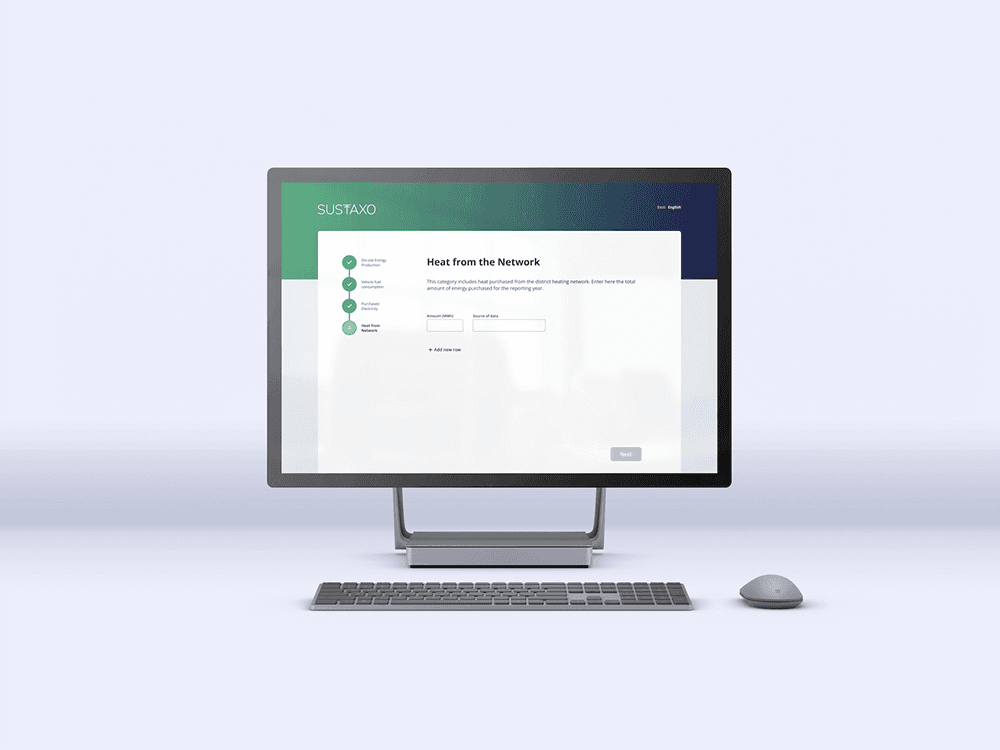
Show where you are. A step indicator shows how many steps there are, which one is active, and which is missing information, so people can see the whole process and plan their time.
Explain instead of making people hunt. Notes and hints say why something is asked and where to find the data. Before, users had to work that out on their own.
Let companies choose their scope. A retail chain can calculate CO2 for the whole company and per store, which shows which parts work well and which need attention.
Smaller fixes: no need to save after every step and skip unrelevant ones, fewer fields and company details such as employees and revenue could come from government databases.
The results
The calculator is clearer and more flexible. People can see the steps ahead, get help where they need it, and measure the scope that fits their business. Based on the limited testing it should let companies measure their CO2 faster, without searching for every piece of information themselves.
Next steps
Next would be to implement some of the changes and see how users respond. The research also showed that small and medium-sized companies often have little reason to calculate their CO2. It isn't needed for day-to-day business and can feel niche. The tech sector is a role model here, because it's easier for those companies to fill in and monitor.